Types of Operating System
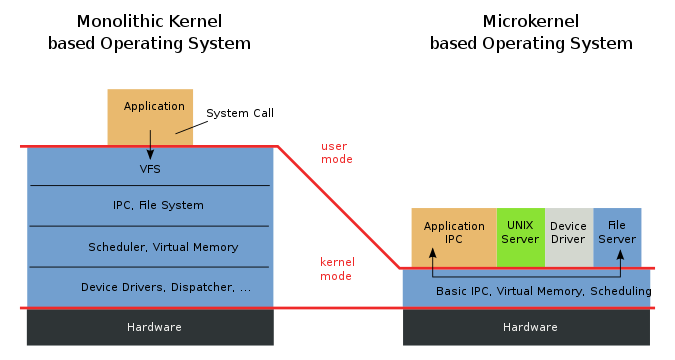
Linux follows the monolithic modular approach
Deadlock
A deadlock occurs when the following four conditions are present simultaneously
Mutual exclusion: Each resource can be assigned to at most one process only.
Hold and wait: Processes hold a resource and may seek an additional resource.
No pre-emption: Processes that have been given a resource cannot be preempted to release their resources.
Circular wait: Every process awaits release of at least one resource held by some other processes
Starvation
In computer science, starvation is a problem encountered in concurrent computing where a process is perpetually denied necessary resources to process its work.
Starvation may be caused by errors in a scheduling or mutual exclusion algorithm, but can also be caused by resource leaks, and can be intentionally caused via a denial-of-service attack such as a fork bomb.
Priority Inversion
priority inversion is a problematic scenario in scheduling in which a high priority task is indirectly preempted by a lower priority task effectively "inverting" the relative priorities of the two tasks.
Fork Bomb
- Simple Batch System
- Multiprogramming Batch System
- Multiprocessor System
- Distributed Operating System
- Realtime Operating System
- Monolithic
- Micro Kernel ( low-level address spacemanagement, thread management, and inter-process communication (IPC) )
Deadlock
A deadlock occurs when the following four conditions are present simultaneously
Mutual exclusion: Each resource can be assigned to at most one process only.
Hold and wait: Processes hold a resource and may seek an additional resource.
No pre-emption: Processes that have been given a resource cannot be preempted to release their resources.
Circular wait: Every process awaits release of at least one resource held by some other processes
Starvation
In computer science, starvation is a problem encountered in concurrent computing where a process is perpetually denied necessary resources to process its work.
Starvation may be caused by errors in a scheduling or mutual exclusion algorithm, but can also be caused by resource leaks, and can be intentionally caused via a denial-of-service attack such as a fork bomb.
Priority Inversion
priority inversion is a problematic scenario in scheduling in which a high priority task is indirectly preempted by a lower priority task effectively "inverting" the relative priorities of the two tasks.
Fork Bomb
In computing, a fork bomb (also called rabbit virus or wabbit[1]) is a denial-of-service attack wherein a processcontinually replicates itself to deplete available system resources, slowing down or crashing the system due toresource starvation.
Comments
Post a Comment